Showing posts with label Ultrasonic Cleaners. Show all posts

Thursday, February 28, 2019

What Exactly Does Precision Cleaning Mean?

The term “precision cleaning” describes a process that requires a clearly defined maximum allowable level of particle, film or impurity contamination on the surfaces to be cleaned. Precision cleaning is usually done with reference to a standard, such as a particle count or film contamination.

Compared to ordinary cleaning wherein a significant amount of impurities on the surface of the parts to be cleaned is removed but doesn't specify how much is left, precision cleaning cleans until the targets for the remaining contamination are reached.

Many industries, including medical, pharmaceutical and aerospace use precision cleaning standards in their manufacturing processes. Coating metal parts, plating components, cleaning tools prior to disinfection and cleaning silicon prior to diffusion, require high standards of cleanliness. It means that an inspection of the part shows that it has been cleaned to confirm any remaining level of contamination is within the permissible tolerances.

Cleaning with chemicals and manual cleaning are some of the methods used for precision cleaning. They may be expensive, time-consuming and labor-intensive. These methods do not guarantee that the parts are thoroughly and precisely cleaned.

Cleaning with ultrasonic cleaners addresses all these drawbacks and offers a complete cleaning solution for precision cleaning needs. Ultrasonic cleaning works by producing high-frequency sound waves at specified power levels in water or in a gentle cleaning solution. The parts to be cleaned are immersed in the cleaning solution and the ultrasonic waves dislodge dirt and contaminants from surfaces. The ultrasonic waves penetrate wherever there is cleaning solution and delivers an even and thorough cleaning action. Ultrasonic cleaning is ideal for parts with intricate shapes, holes, and crevices. Kaijo Shibuya is a leading ultrasonic cleaning manufacturer that offers a complete line of ultrasonic cleaners and components for precision cleaning applications.


The complete article, “What Exactly Does Precision Cleaning Mean?” provides more details about this topic. If you have questions or would like to set up a consultation about using ultrasonic cleaners, contact Kaijo by email at info@kaijo-shibuya.com or calling 408-675-5575.

Wednesday, January 30, 2019

Why Ultrasonic Cleaning Systems Are Used in the Metal Finishing Industry

Metal finishing involves applying coatings or other kinds of treatments to metal parts surfaces. This is to change the metal part's characteristics, harden the surfaces, or preventing corrosion. Ultrasonic cleaning systems are able to clean these metal surfaces quickly and completely.

These metal finishes include electroplating, which uses an electrode in applying a thin metal film to metal parts; plating using a chemical process; and plating which involves pressing a foil of metal onto part surfaces at high temperature and pressure.

For these metal finishing processes to be successful, the underlying metal surfaces have to be completely clean. Otherwise, the coatings may not adhere properly if the contaminants (such as grease or oil) remain on the metal surface.

Clean and contamination free surfaces allow for the proper adhesion of metal coatings, that's why metal parts must be cleaned completely for the coatings and claddings to adhere. Ultrasonic cleaning systems effectively clean metal surfaces quickly and thoroughly.

In ultrasonic cleaning process metal parts to be coated are immersed in a bath of pure water (or water mixed with a mild detergent). A high-powered ultrasonic generator transmits an electrical signal to an ultrasonic transducer that is placed in the bath and produces ultrasonic waves in the liquid at a selected frequency. The sound waves generate tiny cavitation bubbles that produce a strong scrubbing and cleaning action against the metal surfaces in the bath, dislodging particles and removing contaminants.

Other cleaning methods that use chemicals or mechanical cleaning are often used in metal applications. However, the use of ultrasonic cleaning systems and equipment is faster and does not require the use of harsh cleaning chemicals or intense mechanical scrubbing. Since ultrasonic cleaning requires no chemicals costs are reduced and it is more environmentally friendly.


Read our complete article, “Why Ultrasonic Cleaning Systems Are Used in the Metal Finishing Industry” to learn more. If you have questions or would like to set up a consultation, contact Kaijo Shibuya at info@kaijo-shibuya.com or call 408-675-5575.

Tuesday, November 27, 2018

How Ultrasonic Cleaners Provide Green Industrial Cleaning

As chemicals and their safe handing have increased in cost, industrial ultrasonic cleaners provide an ideal alternative that offers substantial savings while reducing negative environmental effects. Ultrasonic cleaners rely on the mechanical scrubbing action of microscopic cavitation bubbles to remove contaminants from the surfaces of the parts being cleaned rather than using harsh chemicals. This cleaning method is completely and does not require the use of harsh or toxic chemicals.

Traditional industrial cleaning methods are costly and time-consuming. In addition, they are generally not environmentally-friendly because they rely on the action of harsh cleaning chemicals to clean parts and components. Various acids or strong solvents are used in the cleaning process, depending on application requirements. After the cleaning application is completed, the chemical wastes need to be neutralized and disposed of in an acceptable manner. Adding to the cost of the traditional industrial cleaning processes are stringent health and safety measures (such as ventilation standards).

The advantages of Industrial ultrasonic cleaners include rapid and effective cleaning and the ability to clean inaccessible places. The use of ultrasonic cleaning also provides a safer, healthier workplace and a more environmentally friendly operation. These aspects provide additional cost advantages.

Since chemicals no longer are required, the extensive chemical handling infrastructure for traditional industrial cleaning methods is eliminated. Toxic and harsh chemicals also have special storage requirements and spills can be expensive. In addition, chemical mixing and delivery to cleaning tanks can are hazardous and the systems that provide this are expensive to set up and maintain. After use, the chemical waste must be neutralized and safely disposed to meet requirements which have become increasingly costly.

Kaijo’s ultrasonic cleaners provide a flexible solution which allows customers to meet the needs of a wide variety of cleaning applications. Using their complete line of ultrasonic cleaning systems and equipment, Kaijo can provide recommendations on a specific system or combination of system components to meet the specific needs of a customer.


The complete article, “How Ultrasonic Cleaners Provide Green Industrial Cleaning” explains more about the benefits of using ultrasonic cleaners. For a free consultation or quote call 408-675-5575 or email info@kaijo-shibuya.com.

Thursday, August 16, 2018

How to Buy the Right Ultrasonic Cleaner for Your Application – Part 2

The most important things to consider in choosing an ultrasonic cleaning system are the size of the tank, the frequency of the system and the power it can provide. Aside from these the accessories such as a tank temperature heater and holding basket should also be considered when choosing the right system for a cleaning application.

Cleaning tank heater:
Ultrasonic cleaners work by generating tiny cavitation bubbles which clean and scrub surfaces of parts to remove contamination. However, when contaminants on surfaces are hard deposits that are difficult to clean, the cleaning action of the bubbles will take more time. In these cases using a heating, the liquid in the cleaning tank will help to soften or loosen the hardened contamination from the surfaces being cleaned. That's where the cleaning tank heater enters the picture.

While cleaning tank heaters are a useful option for ultrasonic cleaning systems, they should be designed for the application. Untreated plain water (below 100 degrees centigrade) may be used most of the time but mild cleaning solutions can also be used. If the cleaning solution is considered, the heat settings should be controlled so that solution won't start boiling. The ultrasonic transducer should also be designed in a way that it will be able to withstand high temperatures.

Using sweep frequencies:
Kaijo’s ultrasonic cleaning systems operate at certain frequencies and are designed to achieve the optimum cleaning results according to the size of the cavitation bubbles and their cleaning intensity. However, a system may experience some unpredictable negative effects. This results in the ultrasonic waves canceling each other and no cleaning occurs. Using sweep frequencies will reduce this effect.

Water resonance system
The water resonance system helps ensure even cleaning action throughout the tank. The water treatment of a water resonance system provides an even distribution of nuclei essential for bubble formation. This allows bubbles to form everywhere within the cleaning solution rather than mostly above the ultrasonic transducer. This provides an even cleaning action on everything placed in the cleaning tank.  


If you’re considering the purchase of an ultrasonic cleaner and have questions after reading the complete article “How to Buy the Right Ultrasonic Cleaner for Your Application – Part 2”, contact Kaijo for a free consultation or quote at 408-675-5575 or email info@kaijo-shibuya.com.

Tuesday, July 31, 2018

How to Buy the Right Ultrasonic Cleaner for Your Application – Part I

Industrial ultrasonic cleaners can effectively clean parts rapidly and completely if they are correctly configured for the specific cleaning application.

An ultrasonic cleaning system typically consists of a signal generator, a transducer, and a cleaning tank. Each component of an ultrasonic cleaning system should be carefully selected, and they must work together so that the entire system can clean parts and tools effectively.

Cleaning application – Ultrasonic cleaners usually remove light contamination like dust, films, and residues quickly and effectively. For cleaning parts that have heavy contamination (such as grease), the application of heat or mild solvents may be added.

Size and power – Effective cleaning also depends on the size of the parts to be cleaned, as well as the power selection. For bigger parts or parts that have unusual shapes, a custom-made tank may be appropriate. Naturally, bigger tanks will require more power than tanks of a standard size. However, too much power can cause pitting on the surfaces of the parts being cleaned, that's why selecting the right amount of power is as important as selecting the right tank size. The bottom line is that the ultrasonic waves need to be evenly distributed in the cleaning tank so that it can clean parts thoroughly and effectively.

Since industrial ultrasonic cleaning is carried out by the high-frequency sound waves in the cleaning solution, the cleaning tank (and the parts inside it) may vibrate slightly as cleaning takes place. This means that the parts should be suspended in the cleaning solution to avoid contact with the walls and the bottom of the cleaning tank, as even slight vibrations can cause damage.


Do you have questions? For more details read the complete article, “How to Buy the Right Ultrasonic Cleaner for Your Application – Part I”. You may also call Kaijo at 408-675-5575 or email info@kaijo-shibuya.com if you have questions or would like to discuss your industrial cleaning needs.

Thursday, May 31, 2018

How Ultrasonic Cleaning Systems Are Used to Clean Industrial Lenses

Ultrasonic cleaning systems can effectively clean glass lenses, however due to the special characteristics of lenses, selecting the correct ultrasonic frequency, power and bath is critical.

Industrial lenses that are made of pure glass are ideal candidates for ultrasonic cleaning. The ultrasonic generator produces high-frequency electronic signal, and the transducer immersed in the ultrasonic bath converts that signal to ultrasonic waves within the liquid.  The waves within the cleaning bath generate cavitation bubbles in the pressure troughs, and then they collapse in the pressure peaks. The action of the cavitation bubbles produces a powerful scrubbing and cleaning action against the hard surfaces of the lenses, dislodging contaminants from the surface.

While glass itself would not be affected by ultrasonic cleaning systems, it may have been treated with a special coating or surface treatments that can be damaged at certain frequencies, in heated baths or when used with added detergents.

Lower frequencies – Produce larger cavitation bubbles with a more robust cleaning action.

High frequencies – Produce smaller cavitation bubbles with a gentler cleaning action.

The power produced by the ultrasonic system affects the cleaning time. If the power is too low, too few bubbles are generated, and the cleaning process will take longer. The power level should be exactly enough so that it can produce the maximum amount of cavitation bubbles that will allow the quickest and most thorough cleaning action on industrial lenses.

Robust cleaning with the addition of detergents and/or heat will speed up the cleaning process on pure glass lens. However, if the lens has any coating, the same cleaning measures may damage the lens coating. Thus, the required frequency for cleaning coated glass lenses must be high enough to avoid damaging coatings that are softer than pure glass.


The complete article, “How Ultrasonic Cleaning Systems Are Used to Clean Industrial Lenses” goes into more detail. If you would like additional information, or have questions, please contact Kaijo through email at info@kaijo-shibuya.com or call (408) 675-5575.

Thursday, March 29, 2018

Using Ultrasonic Cleaners in Disaster Restoration

Items recovered from disasters (like floods, hurricanes, and fires) are often covered with dirt, soot and mold. There are traditional cleaning methods for cleaning recovered items such as wiping, soaking in harsh chemicals or rough mechanical scrubbing. These methods may leave residue or cause damage to these items, while there's little assurance that they would come out completely cleaned.

Ultrasonic cleaning system is the ideal alternative to the traditional methods in cleaning these items.

This system works by generating ultrasonic waves and the tiny cavitation bubbles in the water (or water mixed with a mild detergent). The bubbles form and collapse in time with the frequency of ultrasonic waves. When these bubbles collapse against the surface of the items being cleaned, they create a strong cleaning and scrubbing action, knocking off and loosening dirt and contaminants from the surface.

One of the greatest advantages of ultrasonic cleaning over traditional cleaning methods is that the former cleans the items thoroughly – even items with complicated shapes and hard-to-reach holes and crevices. It cleans effectively and precisely, without the risk of damage to the items being cleaned.

Choosing the right frequency is the key for successful cleaning. For robust items with hard surfaces, opt for the low frequency (26 to 38 kHz) which produces large, energetic cavitation bubbles for the robust cleaning action. For cleaning delicate items, choose higher frequencies (450 to 950 kHz) which generates smaller bubbles for gentler cleaning.

Adding mild but specific solvents to the cleaning solution is required only for cleaning more stubborn dirt and contaminants. This is to ensure rapid and complete cleaning of the items.

Do you need to restore items after a natural disaster? Read the complete article “Using Ultrasonic Cleaners in Disaster Restoration” to learn how ultrasonic cleaners can help. If you have questions, or would like more information, you may contact Kaijo Shibuya by calling 408-675-5575 or by sending an email to info@kaijo-shibuya.com.

Wednesday, February 28, 2018

Using Ultrasonic Cleaners for Medical Devices


Ultrasonic Cleaning Systems are often utilized to clean medical instruments, devices and implants that have delicate, high-precision designs and complex surface geometries. Medical devices typically have various sorts of contaminants and impurities that include carbon deposits, grease, chemical remnants, fungi and bacteria. Because of that, they often require thorough but also gentle cleaning at the same time – and ultrasonic cleaners are effective in addressing these requirements.

The technology used in ultrasonic cleaning systems employ the power of cavitation. When liquids are subjected to strong forces, they tend to fracture and form microscopic bubbles. When these small bubbles form and collapse (often millions of times every second), they create high temperatures and powerful impact over microscopic areas. These are the forces that are utilized by ultrasonic cleaners.

Ultrasonic cleaning systems use powerful high-frequency sound waves to agitate liquid placed in a cleaning bath or tank. This reaction causes cavitation bubbles to form. When medical tools are placed inside the cleaning bath, these microscopic cavitation bubbles form over the surface. As these bubbles form and collapse over the surface of the medical tools, they dislodge impurities from them, with pinpoint precision.

With an 
ultrasonic cleaning system, there is no need to use harsh chemicals or scrubbing that can undermine delicate medical devices and implants. Plus, it's also cost-effective and environmentally safe. Ultrasonic cleaners ensure a powerful, thorough but also gentle and safe cleaning process for delicate medical devices.

Both the CDC (Centers for Disease Control and Prevention) and the WHO (World Health Organization) recommend the use of ultrasonic cleaning technology for medical applications. Ultrasonic cleaners play a vital role to ensuring that medical devices and implants meet high levels of cleanliness. 


For further details read the complete article, “Using Ultrasonic Cleaners for Medical Devices”. After reading it, if you have questions, please contact Kaijo Shibuya via email at info@kaijo-shibuya.com or by calling 408-675-5575.

Wednesday, February 21, 2018

How Medical 3D Printing Benefits from Ultrasonic Cleaning

Hospitals, medical research centers and facilities produce 3D printed models of human body parts or internal organs to create prosthetics for the purposes of surgical procedure, diagnosis, or for educational purposes. Industrial ultrasonic cleaners are now being used to ensure that parts manufactured for medical use are ready for use.

3D-printed models of human body parts and organs are made with build material. The support material, on the other hand, holds the build material until the latter has hardened and self-supporting, and then the support material must be removed to ensure model accuracy. This is where industrial ultrasonic cleaners are used to provide precise cleaning without damaging the material being cleaned.

The ultrasonic cleaning system uses a generator that produces ultrasonic electrical signal. The transducer, then, converts this signal into ultrasonic waves that travel through the cleaning solution inside the tank. Microscopic cavitation bubbles form from the waves, and then collapse in the pressure peaks.

The cavitation bubbles encounter the support material and effectively dislodge it from the build material. The great thing about ultrasonic cleaning is that it doesn't cause any damage to the build material that is being cleaned.

Depending on the 3D model being cleaned, Kaijo’s industrial ultrasonic cleaners can operate at frequencies delivering the precise cleaning strength. Lower frequencies (26 kHz or 38 kHz) produce larger cavitation bubbles which perform a more robust cleaning action on typical 3D models. For more cleaning delicate models or models with fragile material, higher frequencies (450 kHz or 950 kHz) are used to produce smaller bubbles which deliver a gentler cleaning action.

Medical 3D models benefit from ultrasonic cleaning. First, it does rapid and thorough cleaning of support material. Second, it is free from human errors. Third, no harsh chemicals or scrubbing is involved. And fourth, disposal of wastes doesn't require additional measures.


Kaijo can help hospitals and medical facilities realize the benefits of using ultrasonic technology with 3D printing. For more details read the entire article, “How Medical 3D Printing Benefits from Ultrasonic Cleaning”. For a free consultation or quote call Kaijo at 408-675-5575 or email info@kaijo-shibuya.com

Thursday, February 1, 2018

Why Use Ultrasonic Cleaning Systems with a Heater?

Ultrasonic cleaning systems can remove a wide variety of contaminants from the surfaces of parts that need to be cleaned, however removing certain kinds of contaminants require more time than other cleaning applications.

The performance of an ultrasonic cleaning system depends on the parts to be cleaned and the type of the contaminants that have to be removed. For instance, robust parts like automotive components can be typically cleaned in plain water, using the strong cleaning action of the lower frequencies (which produce larger and more energetic bubbles for more robust cleaning). More delicate and fragile parts like semiconductor wafers are usually cleaned using higher frequencies (which produce smaller and less energetic cavitation bubbles for delicate cleaning).

But sometimes, cavitation bubbles alone are not enough to remove tough deposits such as oil-based dirt and grease. That's where additional measures like a mild detergent and heat come into the picture.

In some cases, a combination of a mild detergent and heat can be tailored to a particular object, and the proper selection can help in improving the ultrasonic cleaning system's performance significantly. The detergent increases the solubility of the contaminants while heat softens them. The heat increases the effectiveness of the detergent. These measures will help in removing these contaminants quickly and completely.

Kaijo’s ultrasonic cleaning systems consist of ultrasonic generators (which produce the ultrasonic signal and are selected depending on the frequency needed for the cleaning application), transducers (which should be matched to work with the selected generator), and a tank (which holds the bath and the objects to be cleaned in it).

For cleaning applications requiring heat, both the transducer and the tank should be designed for a heated cleaning solution. Typical temperatures range from 80 degrees Centigrade (or 176 degrees Fahrenheit). Kaijo’s ultrasonic transducers and tanks can accommodate heating requirements up to 100 degrees centigrade (212 degrees Fahrenheit) and the company will work with customers to select right equipment and systems from their full line of products.


Learn more about Kaijo’s ultrasonic cleaning systems by reading our entire article titled “Why Use Ultrasonic Cleaning Systems with a Heater?” For more details contact Kaijo either by email at info@kaijo-shibuya.com or call use a 408-675-5575.

Friday, January 26, 2018

How Ultrasonic Cleaning Systems Promote Profitability

Having an effective cleaning process is essential to many industries. In recent years many companies have made the switch from degreasing and other conventional cleaning processes to a more cost-effective cleaning approach.

The chemicals involved in the conventional cleaning process and are expensive to buy and also need to be safely stored. Another consideration for choosing a new cleaning method is the protection of workers who use these chemicals, plus the safe disposal of toxic waste adds further expense. Other industries need to find alternative cleaning alternatives due to environmental concerns.

In industries that require cleaning of industrial parts and equipment, ultrasonic cleaning systems have emerged as a preferred alternative to traditional cleaning methods. These systems utilize ultrasonic energy to clean contaminated tools or parts.

Ultrasonic energy works rather simply – when dense, elastic media such as water is subjected to high-frequency energy, it expands and contracts quickly as to cause millions of microscopic fractures or tears. The microscopic bubbles that are created form and collapse so quickly that they create a great force. When these bubbles touch close to the surface of an object, the force can knock the contaminants off the surface.

Ultrasonic cleaners consist of a tank that is usually filled with water. A transducer can generate high-energy ultrasonic frequencies between 20 to 200 kHz. When contaminated items are a placed in a bath inside the tank, the ultrasonic waves from the transducer generate millions of tiny cavitation bubbles which do the cleaning action. Depending on the frequency chosen, ultrasonic cleaning systems can do effective cleaning on all parts that range from machinery tools to delicate medical equipment.

Ultrasonic cleaning systems are cost-effective but are also a fast, powerful and safe choice for even the most challenging cleaning applications. It needs little supervision and does not require cleaning with chemicals or the need toxic waste disposal. Since there are very few moving parts ultrasonic cleaners require little maintenance as well.


Read the complete article titled “How Ultrasonic Cleaning Systems Promote Profitability” for more details. If you have questions or need additional information, call Kaijo at 408 675-5575 or email info@kaijo-shibuya.com.

Thursday, December 28, 2017

How Utility Companies Cut Grease, Grime and Costs with Ultrasonic Cleaners

The large compressors are usually used by utility companies to move natural gas through pipelines into storage. The compressors themselves, as well as the engines that drive them, are exposed to a lot of grease, grime and deposits and thus require extensive cleaning and maintenance.

Many utility companies use conventional methods of cleaning those heavily and hardened grease- and oil-based components. However, industrial ultrasonic cleaners now offer a better alternative solution to traditional cleaning methods. They use powerful ultrasonic generators and transducers to generate microscopic bubbles in the cleaning solution. These bubbles act as “scrubbers” which cleans parts quickly and thoroughly.

Traditional cleaning methods use strong cleaning chemicals which may corrode or damage the surface of the parts being cleaned. Using industrial ultrasonic cleaners on the other hand only requires a gentle water-based cleaning solution to clean parts. A mild detergent may also added, and/or the solution can be heated if needed for cleaning off grease and oil-based materials.

Unlike manual scrubbing, microscopic bubbles generated by ultrasonic cleaners can reach inaccessible interior surfaces (such as holes, bolt threads and deep crevices) of the parts being cleaned. The result? When a part is submerged in the ultrasonic tank all surfaces are cleaned equally and completely.

Using industrial ultrasonic cleaners will significantly reduce the need to soak soiled materials in a harsh cleaning solution. Not only will ultrasonic cleaning system will save you time, it will also save you money as well. When machine parts are cleaned down to the bare metal throughout, maintenance is more effective, easier to carry out and provides improved reliability for the compressors and engines. Parts that are completely clean will usually have a longer life and extend the lifetime of the corresponding machines. Overall facility operating performance will be more cost-effective and energy-efficient.

Kaijo can help utilities realize the benefits of using ultrasonic technology. For more details read the entire article, “How Utility Companies Cut Grease, Grime and Costs with Ultrasonic Cleaners”. For a free consultation or quote call Kaijo at 408-675-5575 or email info@kaijo-shibuya.com.  

Thursday, December 21, 2017

The Power behind Ultrasonic Cleaning Systems

Ultrasonic cleaning systems offer an ideal alternative to the traditional cleaning methods, which apply substances or physical contact such as using harsh chemicals or mechanical scrubbing.

But an ultrasonic cleaning system, as the name implies, uses sound rather than substance or scrubbing. It utilizes the principle of cavitation in cleaning contaminated tools and parts.

The principle of cavitation refers to a phenomenon in which disturbances in liquids lead to the creation of short-lived cavities bubbles of gas or vacuum. When the bubbles reach high levels of energy, the bubbles implode and generate a considerable amount of force. The impact created by the imploding bubbles powers the ultrasonic cleaning method.

An ultrasonic cleaning system consists of a tank fitted with a special loudspeaker (transducer) which generates the high-energy ultrasonic waves. As the waves pass through a liquid of water, they reach a desired level of disturbance which leads to the formation of millions of tiny bubbles. As these bubbles form and implode many times each second, they create the cavitation energy needed to dislodge dirt, grease, and grime of the article immersed in the cleaning tank. Despite being tough and effective in removing dirt because of the cavitation energy, these bubbles otherwise will not damage even the most delicate tools.

Kajjo’s ultrasonic cleaning systems offer versatile cleaning ability which are also cost-effective and energy-efficient. A unit has a transducer which produces ultrasonic energy that range from 20 kHz to 1.5 MHz.  These systems employ piezoelectric transducer technology which promises – and delivers – superior cleaning performance over a wider range than other technologies. Piezoelectric transducer technology is far more suitable for ultrasonic cleaning because it has the ability to create ultrasonic sound energy at very high frequencies.


For more information read the complete article titled “The Power behind Ultrasonic Cleaning Systems”. If you would like to learn how ultrasonic cleaning can be effectively used for your application, contact Kaijo for a free consultation or quote at 408-675-5575 or email info@kaijo-shibuya.com.

Thursday, November 16, 2017

3 Big Cost Savings Benefits of Using Ultrasonic Cleaners vs. Spray Washers

If there's one thing that business and facilities owners want when they're considering a cleaning solution, it should be cost-effective.

Ultrasonic cleaners provide an excellent cleaning alternative to other traditional methods of cleaning, like spray washers. Ultrasonic cleaners can clean anything from delicate medical parts to machine parts, and everything in between.

But there are also other ways that business owners can benefit from using ultrasonic cleaners as opposed to spray washers, in relation to the cost:

1. Save on materials
Spray washers rely on large amounts of chemicals to clean stains and require operators to use protective equipment. These concerns are non-existent with ultrasonic cleaners. Cleaning with high-frequency pressure waves does not require chemical action to loosen stains. While it requires a mild detergent to help loosen the most stubborn stains, it is otherwise inexpensive when compared to the number of chemicals used in spray washers.

2. Save on labor costs
The ultrasonic waves generated by these cleaners do not need to be directly aimed at surfaces to be cleaned. The microscopic bubbles travel in every nook and cranny of the tools and parts being cleaned, assuring thorough cleaning. With ultrasonic cleaning, the parts become cleaner with less effort.

3. Save on maintenance
Spray washers may require lots of energy to operate. It has moving parts as well that require expensive maintenance -- if they cannot be maintained regularly, they would eventually lose their usefulness. Customized ultrasonic cleaners do not require much maintenance -- they don't come with moving parts -- all you have is a transducer and a bath of liquid. With very little maintenance, ultrasonic cleaning systems are guaranteed to last a lifetime.

Our complete article “3 Big Cost Savings Benefits of Using Ultrasonic Cleaners vs. Spray Washers” explains in more detail. After you read the article, if you have questions, contact us by calling 408-675-5575 or email us at info@kaijo-shibuya.com.

Thursday, August 24, 2017

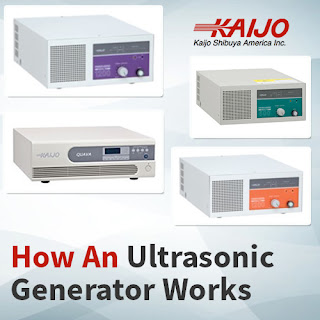
How an Ultrasonic Generator Works

The ultrasonic generator is the heart of an ultrasonic cleaning system. It generates the high-frequency signal, which the ultrasonic transducers convert to sound waves of the cleaning solution within a cleaning tank. In addition to generating the signal, the ultrasonic generator controls the frequency and the power levels to produce several or a range of frequencies as part of an integrated, turnkey solution or independently to power separate transducers.

As the sound waves go through the cleaning liquid, the cavitation bubbles start to emerge in the low-pressure troughs of the waves, then collapse in high-pressure peaks. This action of the microscopic bubbles leads to a powerful scrubbing action that helps dislodge the dirt and particles off the surfaces of parts (in the cleaning liquid of the cleaning tank). The bubbles can even clean hard-to-reach places like holes and crevices, leaving the item thoroughly cleaned. Ultrasonic cleaning systems are generally considered superior to other traditional methods that use chemicals or mechanical scrubbing.

Apart from producing the high-quality signal, Kaijo’s ultrasonic generators provide the frequency needed to optimize cleaning performance for the specific cleaning application. Setting the right frequency is the key factor for an effective cleaning:

·         Low frequency (26 kHz to 38 kHz range) - This frequency produces large, energetic cavitation bubbles, making them suitable for cleaning machined parts, glass, and wires.
·         Mid-range frequency (78 kHz to 160 kHz) - The bubbles become smaller and the cleaning action is gentler. Suitable for cleaning hard disk drives, solar panels, and ceramic parts.
·         High frequency (450 kHz to 950 kHz) - The bubbles become even smaller and the cleaning action is at its most delicate. Suitable for cleaning semiconductors, LED's and fragile medical components.

If an Ultrasonic generator is used with a single process to always clean the same parts, selecting a single-frequency model is a good choice. For general-purpose usage, where the ultrasonic cleaning system may be used in a wide variety of cleaning applications, a generator that can produce a range of frequencies is the best option.


Read the complete article titled “How an Ultrasonic Generator Works” for additional information. If you have questions, want a free consultation or quote, contact Kaijo at 408-675-5575 or send an email to info@kaijo-shibuya.com.

Wednesday, July 5, 2017

Can My Parts Be Cleaned Using Ultrasonics?

Can your manufacturing parts, tools and equipment be cleaned using ultrasonics? The answer is definitely yes. Ultrasonic cleaning works by the action of microscopic bubbles in a cleaning bath usually filled with water (or water with a mild cleaning solvent). As the ultrasonic waves travel through the bath, the waves produce crests of high and low pressure. This generates cavitation bubbles which create an intense cleaning action, leading to the thorough removal of contaminants from the surface of parts, tools or equipment being cleaned.

Ultrasonic cleaning systems deliver an optimum cleaning performance compared to traditional cleaning methods like mechanical scrubbing and harsh chemicals, which are not as effective in cleaning parts and also time-consuming and expensive.

An Ultrasonic cleaning system can increase production facility efficiency by reducing cleaning time, however the right characteristics need to be used for a specific cleaning application. Choosing the right frequency and power level is needed for optimal results in a particular cleaning application.

Systems with low frequencies (26 kHz to 38 kHz) create comparatively large bubbles, ideal for robust cleaning of certain hard surfaces (like steel, copper, and glass). Systems operating at higher frequencies (100 kHz and above) generate smaller bubbles that create a gentle cleaning action for delicate surfaces (such as medical tools and solar cells).

Kajio's Phenix turkey ultrasonic cleaning system proves to be versatile and able to meet a variety of requirements in many typical cleaning applications. The system includes:
·         the ultrasonic generator (which generates the electric signal)
·         the transducer (which converts the electric signal into the ultrasonic waves, from which the cavitation bubbles are ultimately formed)
·         the cleaning tank (which holds the parts to be cleaned, the transducer and the cleaning solution).

The system offers different tank sizes and can operate in sweep or fixed frequency modes. It also provides up to 1200 watts or power at 26kHz or 38 KHz.


For more information read complete article titled “Can My Parts Be Cleaned Using Ultrasonics?” Contact Kaijo’s staff of experts to get a free consultation to determine what Ultrasonic cleaning system will work best for your cleaning application by emailing info@kaijo-shibuya.com or by calling 408-675-5575.

Monday, June 26, 2017

Ultrasonic Cleaning 101: What Are Ultrasonic Waves and How Do They Clean?

How does ultrasonic cleaning work? Ultrasonic cleaning systems use ultrasonic waves to clean parts, tools, and equipment quickly, thoroughly and effectively. Typical features of the ultrasonic cleaning system include an ultrasonic generator, a transducer, and a cleaning tank.

The ultrasonic generator generates an electric signal at the required ultrasonic frequency, which ranges from 26 kHz to 200 kHz; it may be designed for a single frequency or a frequency range.

The transducer is usually submerged in the cleaning solution. Once it receives the electric signal from the ultrasonic generator, it converts the signal into ultrasonic waves in the cleaning solution. When this happens, the transducer's metal plate vibrates at the ultrasonic frequency and fills the liquid with the ultrasonic waves.  High performance industrial ultrasonic cleaners use plain water to clean but adding a mild detergent and heating the solution can assist with some contaminants.

The cleaning tank holds the items to be cleaned, the cleaning liquid and the transducer. It may include a basket to keep the items from touching the tank's walls and bottom, and may also include a heater to warm the liquid.

While all industrial ultrasonic cleaners work in the same way, the operating frequency will influence what kinds of parts can receive the most effective cleaning. Generally lower frequencies are good for heavy dirt and contamination on harder surfaces while higher frequencies are most effective for delicate cleaning applications on softer surfaces.

The ultrasonic waves effectively and thoroughly remove contaminants from the surface of the being cleaned through the action of the cavitation bubbles. The ultrasonic waves produced by the generator travel in the cleaning solution, the peaks, and troughs becoming areas of high and low pressure. The bubbles form and the collapse under low and high pressure, respectively, creating the scrubbing action that lifts the impurities from the surface.

Low frequencies (26 kHz to 38 kHz) create comparatively large bubbles that provide a more intense and robust cleaning action for certain items like glass and metal tools. High frequencies (100 kHz and higher) gives off a gentler cleaning action -- ideal for cleaning delicate tools and parts such as solar cells and medical equipment. Choosing the correct frequency and other features in the ultrasonic cleaning system is critical to ensure optimal cleaning performance.

For more details read the complete article titled “Ultrasonic Cleaning 101: What are Ultrasonic Waves and How Do They Clean?” If you have questions or would like a free quote, send an email to info@kaijo-shibuya.com or call 408-675-5575.

Tuesday, May 23, 2017

How Ultrasonic Cleaners Utilize Cavitation


http://www.kaijo-shibuya.com/industrial-ultrasonic-cleaners-and-equipment
How do industrial ultrasonic cleaners work? They use cavitation in cleaning liquids to remove impurities from the surface of a wide variety of devices and parts that are being cleaned. The action of sound waves produces cavitation bubbles in the cleaning solution. As the sound waves travel through the cleaning liquid, the bubbles emerge under low pressure and collapse in the high-pressure peaks. The very action of these bubbles becomes the scrubbing action which lifts off the impurities from the surface of the items being cleaned while it's immersed in the water (or other mild cleaning solvents) of the cleaning tank.

Ultrasonic cleaning systems have proven to clean tools and parts more quickly, effectively and more thoroughly than traditional cleaning methods like intense scrubbing or use of harsh chemical solvents.

Manufacturing plants that have cleaning requirements for their equipment will definitely benefit from using an ultrasonic cleaning system as it is also economical and environment-friendly.

The action of the cavitation bubbles can be adjusted to various frequencies depending on the cleaning application requirements. Low frequencies (26 kHz-38 kHz the most) will result in large cavitation bubbles that are ideal for robust scrubbing and cleaning but are not suitable for cleaning more delicate parts. Higher frequencies (up to 1 MHz) produce smaller cavitation bubbles that are ideal for gently cleaning more delicate parts like semiconductor devices.

Kaijo offers a complete line of industrial ultrasonic cleaners and equipment. Customers can buy the Phenix III which includes an ultrasonic generator and a tank with the transducers already mounted; or they can purchase the Quava and Phenix Series ultrasonic generators, the tank and the transducers separately. Kaijo can also customize the set-up to meet specific client cleaning requirements, and help select the system that best meets their needs.

Read our complete article “How Ultrasonic Cleaners Utilize Cavitation” to learn about our ultrasonic cleaners. If you want a free quote or consultation, email info@kaijo-shibuya.com or call Kaijo Shibuya at 408-675-5575.