Monday, December 23, 2019

How Ultrasonic Cleaners Protect Components from Rust


Metal components often suffer from rust and/or corrosion if they are not treated and protected, even stainless steel. To prevent corrosion, metal is treated with various finishing processes such as passivation, which consists of increasing the thickness of the oxide layer.

However, for the metal finishing to be effective, it first needs be completely clean before the process is applied. If the part is not completely clean, the oxide layer may leave gaps, which is possible for the rust to attack through the holes. Using industrial ultrasonic cleaners means the impurities are removed and contamination is not an issue.

When contaminants are present, they can prevent passivation process keeping acid away from the surface of the metal. This keeps the thicker layer of chromium oxide from forming. When the surface of the metal is not cleaned completely, passivation may allow some surface areas to rust and may damage the part itself.

Industrial ultrasonic cleaners are the ideal solution to clean various parts, including metals that are to be treated with anti-corrosion finishing processes. Ultrasonic cleaners remove impurities from the metal part surface to allow the finishing to produce a seamless oxide layer.

Industrial ultrasonic cleaners use high-frequency sound waves in a cleaning tank of water to dislodge particles and contamination from the surfaces of metal parts. In an ultrasonic cleaning system, transducers are immersed in a cleaning tank and produce the sound waves in the liquid. The ultrasonic sound waves create microscopic cavitation bubbles that deliver a scrubbing action when in contact with the surface of the parts which are being cleaned. Dirt, oil, grease and other contaminants are easily removed.

Kaijo provides a full product line of Industrial Ultrasonic cleaning equipment that can be used in a wide range of cleaning applications to effectively remove contamination for parts and components. This is something that traditional cleaning with manual scrubbing or using harsh chemicals cannot easily achieve.

The complete article, “How Ultrasonic Cleaners Protect Components from Rust” goes into further detail. If you have questions or would like to set up a free consultation to discuss your particular needs, contact Kaijo Shibuya by email at info@kaijo-shibuya.com or call 408-675-5575.

Monday, December 16, 2019

Using Ultrasonic Cleaning Manufacturer Solar Panels


Solar panels consist of silicon wafers that have been etched and cleaned before being mounted behind glass sheets. Several of the intermediate steps require cleaning of the silicon wafers and glass sheets.

Unlike traditional cleaning methods that use manual scrubbing or harsh chemicals, ultrasonic cleaning systems remove contaminants and residues quickly and completely, while leaving the underlying silicon wafers or glass sheets unaffected.

Making solar cells involve fabrication steps such as etching the silicon, doping the wafers to create positive and negative charge areas and the depositing of conducting and non-reflecting films. The wafers have to be treated with chemicals; they are rinsed thereafter but these chemicals may remain and can shorten the life span of the solar cells and reduce their efficiency.

Silicon wafers may also have to be masked to produce conducive paths on the solar cells (and the masks have to be removed once the conductive film is deposited). Ultrasonic cleaning removes chemical contamination from the surfaces of the wafers and leaves them ready for subsequent fabrication. It can also remove the masking substance without damaging the thin and delicate conducting paths that have been deposited.

After all, the process steps are completed solar cells have to be assembled into bigger units to create solar panels. These solar cells are mounted on a backing, covered by a sheet of glass and sealed. While the solar cells may have been completely clean, the glass sheets may be contaminated or have residues. These contaminants can hurt solar panel functions and break the seals, allowing moisture to penetrate the panel, corrode the conductors, and block the sunlight that produces solar panel power.

Ultrasonic cleaning systems are an ideal solution for cleaning glass surfaces. Using just a bath of plain water, this cleaning method makes sure that no chemical residues are left on the glass surfaces. Traditional cleaning of silicon wafers and glass sheets require special rinsing to remove traces of contaminants. Moreover, they clean too slowly. It also uses harsh chemicals, whose handling, storage and disposal which can be quite costly.

Ultrasonic cleaning, on the other hand, cleans silicon wafers and glass sheets quickly and thoroughly. It also saves money from spending on harsh cleaning chemicals.

Read the complete article “Using Ultrasonic Cleaning to Manufacture Solar Panels” to learn more. If you have questions or would like to set up a free consultation, contact Kaijo Shibuya at 408-675-5575 or email info@kaijo-shibuya.com.

Wednesday, November 20, 2019

When Are High Frequency Ultrasonic Cleaners Needed?

High frequency ultrasonic cleaners are needed when the parts to be cleaned are delicate and easily damaged.

How ultrasonic cleaners clean parts?
Ultrasonic cleaning systems use the scrubbing action of microscopic cavitation bubbles to clean dirt and contaminants from the surface of the parts being cleaned.

The ultrasonic frequency generator produces an electrical signal that the ultrasonic transducer converts to sound waves in the cleaning solution. Cavitation bubbles form in the troughs of the sound waves and collapse in the peaks. When they collapse, the bubbles create many tiny high-energy jets of cleaning solution. If the bubbles are near the surface of the parts being cleaned, the jets hit part the surface and dislodge any contaminants that are present there.

How can cavitation bubbles damage parts?

Selecting the right frequency is one of the keys to achieve the optimal cleaning performance.
Low frequency systems generate larger bubbles that deliver robust cleaning. These bubbles are so powerful that they can effectively remove heavy contaminants, but they can also cause damage to parts made of delicate materials.

High-energy jets produced from low frequency systems can also cause damage to parts with complicated structures such as printed circuit boards. They can also strip away protective coating of plating parts of some materials such as coated lenses, hard disk media or flat panel glass.

High-frequency jets are the key

High-frequency ultrasonic cleaners (over 100 kHz) generate smaller bubbles that deliver gentle cleaning. These bubbles form weaker jets. These jets don't clean as fast as the jets of the lower frequency systems, but they are also too weak to cause damage to delicate parts.

High-frequency bubbles are ideal for cleaning delicate parts and components. They are gentle enough not to cause pitting to soft parts or strip away the coatings, but they have adequate power to remove contaminants that negatively impact the coated parts. The gentle cleaning action of the high-frequency bubbles will maintain the integrity of delicate parts being cleaned.

If you would like additional information, please read the complete article “When Are High Frequency Ultrasonic Cleaners Needed?” Contact Kaijo Shibuya at 408-675-5575 or email info@kaijo-shibuya.com to set up a free consultation to discuss your specific cleaning requirements.

Monday, November 11, 2019

How Ultrasonic Part Cleaners Keep Employees Safe


Ultrasonic cleaning allows workers place the parts in a water-based solution and leave them there for a short period until they are clean. This is in sharp contrast to traditional cleaning methods that require extensive handling of parts, soaking them in harsh chemicals and scrubbing them.

Ultrasonic part cleaners keep the workers safe in many ways:

1) Less handling of parts reduces accidents
Traditional cleaning of parts is labor-intensive. Some parts have complex shapes that may require manual scrubbing. The handling of heavy parts and parts with sharp edges and corners can result in strain, cuts and bruises. Ultrasonic part cleaners minimize handling of parts, thus reducing the risk of accidents and injury.

2) Less use of sharp cleaning tools
Manual cleaning and brushing of contaminated parts consists of using wire brushes and scrapers which can penetrate or cut through protective gloves, thus injuring employees. Ultrasonic part cleaners can clean parts without the use of sharp cleaning tools.

3) Minimized use of harsh chemicals
Traditional cleaning also consists of using harsh chemicals. But storage, handling, use during cleaning of the parts and disposal of these toxic chemicals can present safety hazards to both humans and the environment. Ultrasonic cleaning requires no special solvents beyond mild detergents in a water solution for heavy contamination with grease or oily deposits. Moreover, these detergents are not hazardous and require no special disposal after use.

Ultrasonic parts cleaners are the ideal alternatives to traditional cleaning of parts that require manual scrubbing or using toxic cleaning chemicals. Moreover, they clean the parts quickly, thoroughly and effectively while keeping the workers and the work environment safe.  Employees simply place the parts to be cleaned in ultrasonic cleaning tanks turn on the system to run for a specified time.

For more details read the completed article titled “How Ultrasonic Part Cleaners Keep Employees Safe”. If you want a free consultation or quote, please contact Kaijo at 408-675-5575 or email info@kaijo-shibuya.com.

Tuesday, October 29, 2019

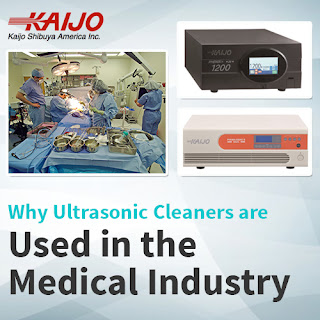
Why Ultrasonic Cleaners Are Used in the Medical Industry


Since medical devices are often delicate and have high cleaning standards, industrial ultrasonic cleaners provide an ideal solution, offering gentle cleaning and complete removal of contaminants.

Medical devices that include surgical instruments and medical implants are used inside the body and are subject to extremely high standards of cleanliness and sterility. In addition, medical devices have complex structures that mean intricate surfaces, tiny crevices, dead-end holes and even inside slots and threaded holes.

Many medical devices cannot be exposed to heat, harsh cleaning chemicals and intense scrubbing which are typically used in traditional cleaning methods. Not only these methods costly and cause potential damage to medical devices, but they also do not guarantee that they provide complete cleaning.

Industrial ultrasonic cleaners rely on sound waves, which produce microscopic cavitation bubbles in the cleaning solution. The formation and collapse of these bubbles agitate the cleaning solution near the medical device surfaces to dislodge any dirt or contamination that may be present.

Low ultrasonic frequencies produce comparatively large bubbles with an intense cleaning action for rugged devices. High ultrasonic frequencies, on the other hand, produce smaller bubbles with a gentle cleaning action which is the frequency used to clean delicate parts such as medical devices.

No matter how complex medical devices are, once they are immersed in the cleaning solution, the microscopic cavitation bubbles are formed inside the tiniest crevices and dislodge any contaminants, cleaning down to the original surface. A complete cleaning is extremely important, especially for implants. If these implants still have leftover contaminants due to improper and incomplete cleaning, it could result in the rejection of the implants.

 While industrial ultrasonic cleaning systems effectively remove contaminants, they do not, by themselves, kill or eliminate bacteria. Thus, adding a sterilizing solvent to the cleaning solution helps the cleaning action process and the action of the cleaning bubbles heightens the sterilizing effect as well.

For more information read the complete article, “Why Ultrasonic Cleaners Are Used in Medical Industry”. Contact Kaijo for a free consultation or quote by email info@kaijo-shibuya.com or call 408–675–5575 to discuss your cleaning requirements.

Wednesday, October 16, 2019

Selecting the Right Ultrasonic Tank and Transducer for Your Application


An ultrasonic cleaning system consists of several different components:

  • Ultrasonic generator – Produces the electric ultrasonic frequency;
  • Transducer – Converts the electric signal to sound waves; and
  • Tank – Holds the cleaning solution and the parts to be cleaned.
Choosing the right ultrasonic cleaning tank and transducer for your specific application helps ensure that the ultrasonic cleaning system works as expected and satisfies the requirements of your cleaning application.

When selecting the right tank, you need to consider several characteristics:

  • Size – the tank must be large enough to hold the cleaning solution and the parts to be cleaned and not over-sized which results in inefficient operation.
  • Basket – the basket holds the smaller parts, so that they won't be damaged against the tank’s bottom and walls from the vibration caused by the ultrasonic frequency.
  • Heating – some cleaning applications will benefit from a tank that can distribute heat in the cleaning solution.
  • Thickness of tank material – the thickness of the tank enhances the sound distribution and prevents cracking.
Ultrasonic cleaning transducers are sealed metal containers that can be either immersible, bolt-on, or directly mounted types:

  • Immersible ultrasonic transducers – are the most flexible type of transducers because they can be moved and placed in any tank. It is waterproof and is attached to a cable, which is then plugged into the ultrasonic generator. It can be suspended in the cleaning solution to produce the ultrasonic sound waves.
  • Bolt-on transducers – are fixed to the bottom or sides of the cleaning tank. Bolt-on transducers can be exchanged but they are not as flexible as immersible transducers.
  • Mounted transducer – it is fixed to the bottom or sides of the cleaning tank. Mounted transducers often come with turnkey systems and are integrated into the ultrasonic cleaning system.
 It is also important to choose the right ultrasonic cleaning tank and transducer combination. Kaijo provides expert advice for ultrasonic cleaning installations to ensure your system delivers the performance you expect.

Read the complete article “Selecting the Right Ultrasonic Tank and Transducer for Your Application” to learn more. Contact Kaijo Shibuya at 408-675-5575 or email info@kaijo-shibuya.com if you have questions or want a free consultation on choosing the right ultrasonic system for your needs.

Thursday, September 26, 2019

How Ultrasonic Cleaning Systems Eliminate Manufacturing Production Delays


Incomplete cleaning of tools and parts used in manufacturing production lines, such as cleaning injection molds, can result to slow operation, down times and overall operation and production delays.

The use of ultrasonic cleaning systems ensures that cleaning injection molds and related parts are completely and properly cleaned. It also reduces the time needed for finding and solving cleaning problems that are usually encountered with conventional cleaning methods.

The use of
ultrasonic cleaning technology allows even hard to clean part surfaces and textures to be completely and effectively cleaned. The ultrasonic waves result in the formation and collapse of the cavitation bubbles in the cleaning solution. This action of cleaning bubbles helps in dislodging contamination and other undesirable particles from the surfaces of the parts that are being cleaned. The cavitation bubbles can even clean intricate shapes and hard-to-reach places of the parts being cleaned.

To achieve the optimum cleaning performance in an ultrasonic cleaning system, the right tank size, power and frequency levels should be selected carefully.

The
ultrasonic cleaning system is so effective that it doesn't need aggressive cleaning chemicals or use mechanical scrubbing action. Operator safety is greatly enhanced and costs for the use, handling, storage and disposal of chemicals are eliminated. With the elimination of chemicals, the ultrasonic cleaning system is also environmentally compliant.

For more details read the complete article “How Ultrasonic Cleaning Systems Eliminate Manufacturing Production Delays” to learn how Kaijo can help you. For a free consultation or quote call 408-675-5575 or email to info@kaijo-shibuya.com. Ultrasonic cleaning systems are an ideal solution for quick, thorough and efficient cleaning of industrial and manufacturing parts, such as injection molds. Using a proactive cleaning process, you won't have to encounter down times and unnecessary production delays any longer.